When a company asks us for an AI workshop, the real problem is almost never that the team does not know how to use artificial intelligence. The problem is that nobody knows where to start.
And that is already a diagnostic waiting to happen.
Many organizations arrive at 2026 with the same line: "we know we need AI, but we are not clear on where." There is pressure from the board, there is budget allocated, there is some stray pilot. What is missing is the judgment to decide where AI genuinely adds value and where it is expensive noise. A well-designed AI workshop for companies does not solve that by teaching people to write prompts. It solves it by showing, in two or three hours, where the company actually stands.
There is a wide gap between what the company asks for and what the company needs. It asks for training. It needs orientation.
The underlying data explains it. According to DataCamp's 2026 report, 82% of companies already offer some form of AI training, but 59% still report an internal skills gap. In other words: they do train. The generic course is not moving the needle. When a company asks again for "a workshop," it is often asking, without realizing it, for someone to tell it what is wrong before deciding what to train.
That shift in lens changes everything. If you walk in thinking "I am here to teach," you deliver the same module as always. If you walk in thinking "I am here to understand where this company is," the AI workshop becomes the entry point to something far more useful.
An AI workshop is a short working session, two to three hours, where an outside team and the company's key people explore real use cases together. Its value is not teaching tools, but revealing the organization's maturity: what data exists, which processes are automatable, and what judgment the team has. It works as a rapid diagnostic.
When the workshop is designed as a diagnostic, three things that were blurry come into focus.
The first is where the data is fragmented. Most companies discover in the workshop that their main obstacle to AI is not a model, it is that their data lives in silos that do not talk to each other. Without infrastructure ready for AI, any agent you deploy starts on the back foot.
The second is which processes are real candidates for automation and which are not. Not everything that can be automated is worth automating. The workshop separates the processes with volume, clear rules, and a measurable result (the ones that pay off fast) from the ones that are not mature yet.
The third, and the most uncomfortable, is who on the team already has judgment and who needs a foundation. This connects to a key DataCamp finding: the biggest capability gap in 2026 is not in advanced engineering, but in judgment skills, in knowing how to read an output and decide whether it is reliable. As the tools get easier, that judgment becomes scarcer, not more common.
None of this is visible before the workshop. It becomes visible during. That is why the workshop is not the course: it is the diagnostic wrapped as training, and that is why the organization lets it in without the usual resistance.
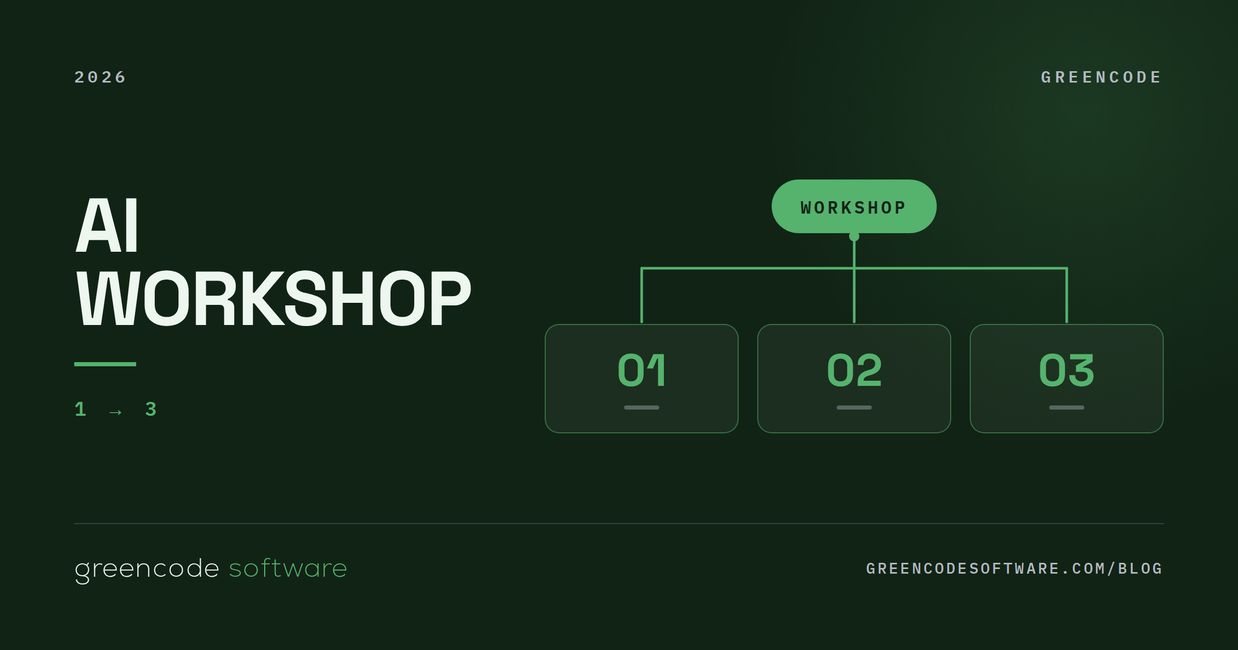
In our experience, the workshop usually leads to three possible paths. None is defined beforehand. They are defined by what the diagnostic reveals.
Sometimes the team has the tools but lacks method. Here the way out is not buying more software, it is applied training on real work. Not a generic video module, but learning embedded in how work actually gets done. DataCamp is clear on this: passive, one-off training does not work in a field that changes every month. What pays off is reinforced practice, by role and on the team's own cases.
Other times, the organization does not yet know its maturity level and needs to know it before investing. The way out is a digital maturity assessment and an AI adoption roadmap with expected ROI by stage. It is the path that gives the CFO what they ask for: a plan where each stage is validated before committing to the next.
And sometimes a specific, ready need shows up. The way out is to scope that case and build a concrete solution, with measurable impact from the start. From the workshop straight to an agent in production that moves a real number.
A workshop can be a great diagnostic or it can be a morning's expense. The difference is in what happens next.
The most common mistake of 2026, according to DataCamp, is treating training as a one-time event. 40% of companies use video courses as their main AI training format, and their own leaders admit that format makes it hard to apply what was learned to real work. A session that ends in applause and leaves neither a metric nor a next step is not a program: it is corporate entertainment.
The way to avoid it is to treat the workshop as the start of a measurable process, not the close of an initiative. It ends with a map of where the company is, a chosen path out of the three, and a baseline to measure against. Selling a solution without that prior diagnostic is guessing. And guessing with the client's AI budget is expensive for both sides.
At first, we also treated the workshop as training. We prepared content, delivered it, people left happy. And often nothing happened afterward.
What changed was realizing that the workshop's value was not in what we taught, but in what we listened to. We started using those hours to survey the ground: what data they have, which processes hurt, who in the room understands what we are talking about and who nods out of politeness. Almost always, halfway through the workshop, the real problem surfaced, and it was almost never the one they had raised when they hired us.
One case repeats itself: they called us to "train the team on AI" and we ended up redesigning an entire billing process, because what the workshop revealed was not a lack of knowledge, but an operational bottleneck no training would ever fix. The team did not need a course. It needed someone to look at the process with them. That is the work a good workshop does when you let it be what it actually is.
An effective AI workshop runs two to three hours. It does not aim to cover theory, but to explore the company's real use cases and reveal its maturity: data, processes, and the team's judgment. That short format is enough to diagnose where to start without draining the decision-makers' calendars.
AI training aims to transfer knowledge about tools. An AI workshop, understood as a diagnostic, aims to understand where the company stands. Training assumes you already know what you need to learn; the workshop reveals that first. That is why it is better to start with the diagnostic and only then define what to train.
Not by buying a tool, but with a diagnostic. An AI workshop shows in a few hours what data and processes you have, where AI genuinely adds value, and what level of judgment your team has. From there the path is defined: training, an adoption roadmap, or a concrete implementation.
If your company knows it needs AI but is not clear on where to start, do not look for training first. Look for a diagnostic. A well-designed AI workshop shows you in two or three hours where you stand, what data and processes you have, and which of the three paths is yours. You leave knowing, not guessing.
At Greencode, that workshop is the entry point, not the close. If you want to stop having abstract conversations about AI and start seeing where it genuinely adds value in your operation, let's build one and find out together which path is yours.
In 30 minutes we identify the highest-impact opportunity for your business and show you exactly how it gets implemented.


