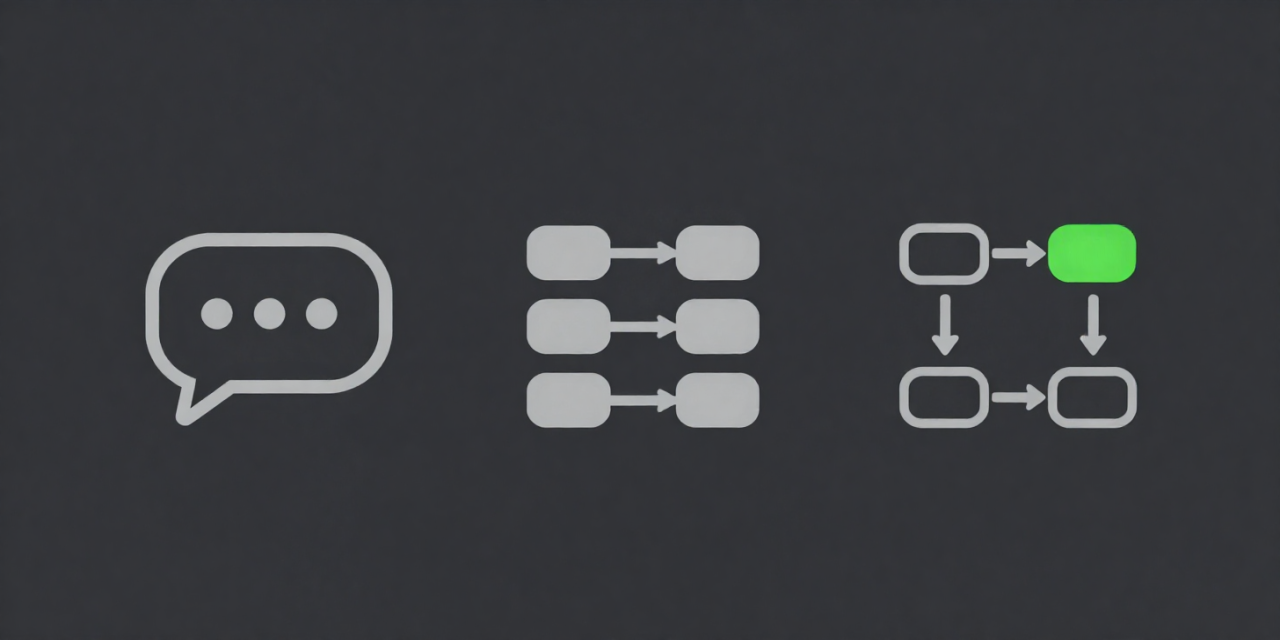
If your company still calls everything that uses AI a "chatbot," you're making technology investment decisions with the wrong map. Chatbots, process automation, and AI agents solve different problems, cost different amounts, and scale differently. Confusing them is the most expensive mistake of 2026.
This guide explains the real distinction — no marketing jargon — so you can make the right call for your business. At the end, a 5-question framework to pinpoint exactly which one you need right now.
A chatbot is an automated response system that operates within a decision tree or predefined flows. The user says X, the bot replies Y. More sophisticated versions incorporate basic NLP to recognize intent, but the underlying logic remains reactive and bounded.
The critical constraint: a chatbot doesn't execute actions in external systems. It cannot process a return, update an order in your ERP, or send a follow-up email. It guides the user to the point where a person — or a connected system — does the actual work.
Key stat: 74% of Latin American consumers say they'd only use a chatbot if it resolves their problem quickly. The majority report that traditional bots are "conversational dead ends" that frustrate users and overwhelm support teams. (Frost & Sullivan / Cari AI LATAM, 2026)
When does a chatbot make sense? For companies with 3–5 highly defined FAQs, moderate inquiry volume, and a support team that can take over when the bot can't answer. It's the entry point into automation — not the destination.
Bottom line: A chatbot responds. It doesn't act, doesn't learn in real time, and doesn't connect to your systems. It reduces repetitive support load — it doesn't transform your operations.
Process automation (typically implemented with tools like n8n, Zapier, or Make) connects systems and executes workflows without human intervention. Unlike a chatbot, it actually acts: it can issue an invoice, generate a report, classify an email and route it to the right team, or sync data between your CRM and inventory system.
The key limitation is that it follows predefined paths. If a process hits an exception not covered by the flow, it breaks or stalls. It doesn't reason, doesn't make decisions outside the script. Think of it as smart plumbing: it reliably moves information from one place to another — but it doesn't improvise.
Industry data point: 89% of mid-market firms use only partial accounts payable automation. Most are still processing invoices manually in Excel despite having tools available. The bottleneck isn't technology — it's not knowing where to start automating, or how to do it without operational risk.
When does process automation make sense? When your team loses more than 10 hours a week on repetitive, predictable tasks: invoicing, reporting, email classification, order tracking, data entry. ROI is immediate and measurable — often visible within the first 30 days.
Bottom line: Process automation connects systems and executes tasks. It's deterministic — it follows fixed rules. Ideal for eliminating predictable manual work. Not built to resolve exceptions, make complex decisions, or manage unstructured conversations.
An AI agent is a system that perceives its environment, reasons about it, plans a sequence of actions, and executes them autonomously to achieve a goal. It doesn't follow a script: it makes decisions, uses external tools (APIs, databases, internal systems), manages exceptions, and learns from the context of the conversation or process.
The difference isn't cosmetic. A chatbot answers. An AI agent completes. For example: an AI sales agent for e-commerce doesn't just reply "is that product in stock?" — it queries live inventory, checks whether there's an active promotion for that user based on their purchase history, generates the order, and sends the confirmation. All without constant human supervision.
Key stat: 46% projected CAGR for the AI agent market through 2030. The market grew from USD 8B in 2025 to USD 11.7B in 2026. Gartner estimates agentic AI spending in 2026 is 141% higher than in 2025. (Gartner, IDC, Belitsoft AI Agent Forecast 2026)
The trap that catches 62% of companies: Many companies invest in "AI agents" that are really chatbots with an LLM bolted on the back end. The litmus test is simple: can the system execute actions in your internal systems without a human intervening? If the answer is no, it's a chatbot with good PR — not an agent.
Bottom line: An AI agent reasons, decides, and acts. It doesn't follow a fixed script — it manages exceptions, uses tools, and operates autonomously. It's the only one of the three that can genuinely transform a company's operating model.
Here's how the three technologies compare across the dimensions that matter most for your business decision:
Your company receives more than 200 monthly inquiries about the same 5–10 questions — hours, pricing, availability, return policies. Typical example: a D2C brand with a 3-person support team buried in the same questions on WhatsApp or email every day.
Your team spends more than 10 hours a week on repetitive, predictable tasks: issuing invoices, generating reports, classifying emails, manually updating the CRM. Typical example: a 40-person agency manually sending client performance reports every Monday morning.
Your operation has processes that require decisions — not just execution. Abandoned cart recovery with purchase-history personalization, Tier-2 support that resolves without escalating to humans, or real-time data analysis to recommend actions. Typical example: an e-commerce company with $10M+ in revenue losing sales to slow response times outside business hours.
Bottom line: These technologies aren't competitors — they're complementary layers. Most mature companies use all three: chatbots for FAQ deflection, automation for internal operations, and AI agents for processes that require reasoning and autonomous action.
Enthusiasm for AI agents is justified, but adoption numbers reveal a massive gap between pilots and production. Understanding why they fail is as strategic as knowing when to deploy them.
Key stat: 85% of AI projects fail due to poor data quality. A pilot can work with a clean, static spreadsheet — but a production model faces a constant stream of dirty, incomplete, or poorly structured data. Before deploying an agent, your data must be production-ready. (Gartner, 2026)
The three root causes of agentic project cancellations (Gartner and Dynatrace, 2026):
Bottom line: Gartner's 40% cancellation rate isn't a technology problem — it's an organizational architecture problem. Companies that scale successfully have clean data, governance from day one, and maximum leadership commitment.
Answer these five questions in order. The last one you answer "yes" to defines your optimal entry point.
What's the single most important difference between a chatbot and an AI agent?
A chatbot responds within a predefined script. An AI agent makes decisions, executes actions in external systems, and handles exceptions autonomously. A chatbot reduces support load — an AI agent transforms your operating model.
How long does it take to implement an AI agent in a 100–300 person company?
A pilot on a single high-impact real process takes 6–12 weeks, with measurable results from week 8. The most critical factor is data quality and leadership commitment.
Why do 40% of agentic AI projects get cancelled?
Per Gartner (2026): poor data quality, lack of governance from the start, and unclear business value. 85% of AI projects fail due to data quality issues in production.
Do I need an internal technical team to implement process automation?
No. With tools like n8n and a specialized partner, a 20–300 employee company can automate invoicing, reporting, and email workflows without internal developers.
All three technologies are valid. Chatbots have their place, automation has its own, and AI agents are redefining what's operationally possible. The mistake isn't choosing the "worst" technology — it's choosing the wrong technology for the problem you have today.
The practical rule for 2026: start with your most costly and most concrete pain point. If it's after-hours support coverage, a conversational agent. If it's team time absorbed by repetitive tasks, process automation. If it's the inability to scale without hiring more headcount, AI agents with an 8-week pilot on one real process.
The AI agent market in Latin America is worth USD 5.79 billion today and will reach USD 34.62 billion by 2033. Companies that implement correctly in the next 18 months will have an operational advantage that will be very difficult to close for those who wait.
In 30 minutes we identify the highest-impact opportunity for your business and show you exactly how it gets implemented.


